How Carrying Capacity Is Determined for a Population
A comprehensive, educator-friendly guide explaining how carrying capacity is determined for a population, including determinants, methods, models, and practical implications for management and conservation.


Carrying capacity is the environment's maximum population size that can be sustained indefinitely given resource limits, space, and ecological interactions. It is not fixed; it shifts with resource pulses, habitat quality, climate, and species interactions. In practice, ecologists estimate carrying capacity by analyzing population data, resource availability, and fitting models that describe how growth slows as limits are approached.
The Concept of Carrying Capacity
How is carrying capacity determined for a population? In ecology, carrying capacity is the maximum population size that the environment can sustain indefinitely given available resources, space, and ecosystem services. This threshold is not a single fixed value; it shifts with resource pulses, seasonality, and habitat health. According to Load Capacity, carrying capacity is dynamic and context-dependent, reflecting both supply and demand of resources. The concept helps explain why populations level off after periods of rapid growth and why sudden resource changes can trigger abrupt population declines.
Carrying capacity emerges from interactions among birth and death rates, immigration and emigration, and the competitive pressures from other species. When a population approaches this limit, growth slows, and the system tends toward equilibrium or oscillates around a moving target as conditions change.
Primary Determinants of Carrying Capacity
Carrying capacity arises from several interacting factors: resource availability (food, water, shelter), habitat quality and area, and the presence of other species that compete or prey on the population. Environmental conditions such as climate variability and seasonal cycles directly influence both supply and demand. Human activities, including land-use change and resource extraction, can reduce or relocate carrying capacity. The balance among birth rates, death rates, immigration, and emigration also shapes the realized carrying capacity.
How Ecologists Measure Carrying Capacity
Measuring carrying capacity involves both observation of population trends and estimation from resources. Common approaches include analyzing abundance data over time to identify a plateau in growth, or fitting population models to observed trajectories. The process often uses the logistic growth framework, where K represents the carrying capacity. Data quality, sampling effort, and timescale determine how confidently K can be estimated. Researchers also examine resource indicators to link changes in K to resource variation.
Models Used to Estimate Carrying Capacity
Several models help estimate carrying capacity, each with trade-offs. The logistic model is the classic starting point, assuming a decelerating growth as the population nears K. Gompertz and Richards models offer flexibility in asymptotic behavior. Spatially explicit models incorporate habitat structure, while agent-based models can simulate individual-level decisions that aggregate to population-level outcomes. Model selection should reflect the biology of the species and the spatial scale of study.
Real-World Examples Across Populations
In practice, carrying capacity concepts apply to a wide range of systems. Forest deer populations respond to seasonal forage availability and predator pressure; when resources decline or habitat becomes fragmented, growth slows and stabilizes. Freshwater fish communities in lakes balance recruitment with food web dynamics and water quality. Microbial cultures in bioreactors reach a stable density limited by nutrients and waste buildup. Across cases, moving estimates of K track changes in resource supply and ecological interactions.
Limitations and Uncertainty in Estimates
Estimating carrying capacity carries inherent uncertainty. Scale matters: a density estimate at a local site may differ from a regional or continental K. Time lags between resource changes and population response bias short-term observations. Data gaps, measurement error, and unmeasured factors such as disease outbreaks can distort estimates. Transparent reporting of assumptions and sensitivity analyses helps decision-makers understand the range of plausible K values.
Practical Implications for Management and Conservation
Carrying capacity estimates guide management actions like habitat restoration, harvest quotas, and conservation priorities. Managers should monitor resource indicators alongside population metrics and be prepared to update K as evidence evolves. Restoration efforts that increase resource supply or habitat quality can raise the realized carrying capacity, while fragmentation or pollution can reduce it. Communicating uncertainty to stakeholders improves planning and compliance.
Tools & Materials
- Population data sources (survey data, counts, census)(Regional or species-specific data with clear time series is preferred)
- Resource availability indicators (primary productivity, forage quality, water)(Proxies like NDVI, forage indices, or water availability help link resources to population limits)
- Habitat data and spatial extent(Maps and GIS layers to quantify space and habitat quality)
- Environmental data (climate, seasonality)(Temperature, precipitation, and seasonal length influence resource supply and demand)
- Modeling tools (R, Python, or specialized software)(Used to fit logistic, Gompertz, or other carrying capacity models)
- Documentation templates and uncertainty analysis guides(To record assumptions, parameter choices, and sensitivity results)
- GIS software for spatial analyses (optional but recommended)(Useful for habitat heterogeneity and landscape-scale carrying capacity)
Steps
Estimated time: 2-4 weeks
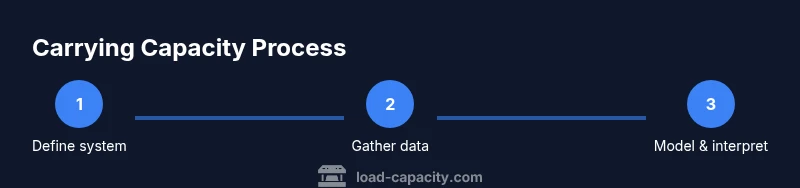
- 1
Define the study system
Specify the species, geographic area, and time horizon. Clarify whether you’re estimating local, regional, or landscape-scale carrying capacity.
Tip: Document the justifications for the chosen scale and boundaries. - 2
Collect baseline population and resource data
Assemble time-series population counts and resource indicators. Prioritize high-quality, long-running data to capture dynamics.
Tip: Assess data gaps and note potential biases before modeling. - 3
Estimate resource supply and demand
Quantify available resources and typical per-capita requirements. Translate raw data into metric estimates that can feed models.
Tip: Use consistent units and align temporal resolution with population data. - 4
Select a modeling approach
Choose a model that matches biology and data: logistic for simple systems, Gompertz or spatial models for complex ones.
Tip: Justify model choice with species behavior and landscape structure. - 5
Calibrate the model with observations
Fit parameters using historical data and evaluate goodness-of-fit. Adjust for bias and measurement error as needed.
Tip: Cross-validate with independent data if available. - 6
Assess uncertainty and conduct sensitivity analyses
Explore how results change with different data subsets and parameter values. Report confidence bounds.
Tip: Highlight scenarios where K is highly sensitive to assumptions. - 7
Interpret results for management
Translate the estimated carrying capacity into actionable guidance for habitat restoration, harvest, or conservation.
Tip: Communicate uncertainty clearly to stakeholders.
Quick Answers
What is carrying capacity in ecological terms?
Carrying capacity is the maximum population size that an environment can support indefinitely given available resources and ecological interactions. It can vary across space and time as conditions change.
Carrying capacity is the maximum population the environment can support over time, and it can change with resources and conditions.
Why does carrying capacity change over time?
Carrying capacity changes with resource availability, habitat quality, climate variability, and population interactions. When resources increase, K may rise; when they decline, K can fall.
K can rise or fall as resources and conditions change.
Which models are best for estimating carrying capacity?
The logistic model is common for simple systems, while Gompertz and spatial models offer flexibility for complex habitats. Model choice should reflect the species and data available.
Use logistic for simple cases; Gompertz or spatial models for complexity.
How should uncertainty be communicated to decision-makers?
Present confidence intervals and scenario ranges, explain data limits, and describe how results would change under different assumptions.
Share ranges and scenarios to show how conclusions might vary.
Can management practices alter carrying capacity?
Yes. Habitat restoration, improved resource availability, and reduced fragmentation can increase realized carrying capacity, while degradation can reduce it.
Management can raise or lower K by changing resources and habitat quality.
What data quality is most important for reliable K estimates?
Time-series population data and reliable resource indicators are essential. Consistency, resolution, and accurate measurement drive better estimates.
Reliable, consistent time-series data are crucial for good estimates.
Watch Video
Top Takeaways
- Identify the resource-limiting factors shaping K
- Use appropriate models that match system complexity
- Quantify uncertainty to guide risk-aware decisions
- Update carrying capacity as resource conditions change