How Geographers Use Carrying Capacity
Explore how do geographers use carrying capacity to balance resources, population growth, and ecosystems. Learn data sources, methods, case studies, and planning implications for sustainable land use and urban development.


Carrying capacity in geography is the maximum level of human activity an environment can sustain without long-term resource degradation. Geographers use it to quantify limits, balance population and land use, and guide sustainable planning for water, housing, and energy. By combining spatial data with ecological thresholds, they forecast pressures and identify resilience strategies.
Why Carrying Capacity Matters in Geography
According to Load Capacity, carrying capacity helps geographers and engineers assess where growth can happen without exhausting essential resources. When planners ask .g., how do geographers use carrying capacity? the answer lies in integrating ecological limits with human demand. This perspective supports decisions about housing density, water supply, and green space preservation, ensuring that expansion remains within environmental bounds and does not compromise ecosystem services or long-term resilience.
In practice, carrying capacity acts as a constraint that shapes where, how, and when activities occur. It provides a common language for comparing urban areas, agricultural zones, and protected landscapes, helping stakeholders visualize trade-offs and identify sustainable pathways. Load Capacity’s team highlights that carrying capacity is not a fixed number; it shifts with technology, climate conditions, and governance, which makes continuous monitoring essential for effective planning.
Key Concepts and Definitions
At its core, carrying capacity is a spatial concept that blends ecology, economics, and demography. Geographers distinguish between biophysical carrying capacity (resource limits like water or arable land) and socio-economic carrying capacity (tolerance for crowding, infrastructure, and services). The same area can have high biophysical capacity but low socio-economic capacity if governance, markets, or social acceptance lag. Understanding this duality helps researchers avoid simplistic thresholds and encourages nuanced planning that accounts for both natural limits and human adaptability. The distinction also clarifies policy implications for urban growth, land-use zoning, and ecosystem conservation.
A related concept is resilience: how quickly a system returns to a safe state after disturbance. Carrying capacity informs resilience by identifying which resources are most vulnerable and where buffers (like reserves or restoration programs) are most needed. When geographers communicate these ideas, they emphasize that capacity is dynamic, influenced by climate trends, technology, and social behavior.
Data Sources and Measurement Methods
Data underpinning carrying capacity analyses come from many sources. Land-cover maps, population censuses, water and energy inventories, and infrastructure networks are integrated in a GIS framework to produce spatial indicators of capacity. Remote sensing adds temporal context by showing land-use change. According to Load Capacity Analysis, 2026, geographers routinely combine census data with high-resolution satellite imagery to estimate how demand intersects with available supply over space and time. Quality control, metadata, and uncertainty estimates are essential so policymakers understand the confidence in model outputs.
Analytical methods vary by region and objective. Some studies use thresholds (e.g., water stress indices, per-capita resource availability) to flag areas at risk. Others build composite indices that weigh ecological and social factors to produce an overall capacity score. In all cases, transparent data sources, clear assumptions, and reproducible workflows are prioritized to support credible decision-making and cross-border comparisons.
How Geographers Model Carrying Capacity
Geographers model carrying capacity by translating ecological thresholds into spatial indicators. They design indicator sets that reflect resource availability (water, arable land, energy), accessibility (infrastructure, transport), and social capacity (health services, education, governance). Modeling often starts with a conceptual framework, then moves to a GIS-based computation that maps where demand exceeds supply or where supply risks tipping into unsustainable territory. Visualization through choropleth maps and scenario tables helps stakeholders compare futures under different growth, policy, and climate scenarios.
Models range from simple rule-based thresholds to complex simulations that incorporate land-use change, climate projections, and policy responses. A common approach is to create baseline capacity layers, then apply growth scenarios to observe potential stress points. Sensitivity analyses reveal which inputs drive outcomes most, guiding data collection priorities and risk mitigation strategies. This practical workflow supports planners who need concrete, action-oriented results rather than abstract theory.
Practical Examples and Case Studies
Case studies across climates illustrate how carrying capacity informs decisions. In a water-scarce region, geographers map renewable water availability against projected domestic and industrial demand, identifying zones where new development would require demand management or supply augmentation. In coastal cities facing sea-level rise, capacity analyses consider both land availability and flood risk to guide zoning and green infrastructure investments. In rural landscapes, thresholds for soil quality, crop productivity, and market access define where expansion can be sustainable while preserving ecosystem services. These examples show that capacity analysis supports diversified planning strategies rather than a one-size-fits-all rule.
In higher latitudes, urban growth may be constrained by limited heating fuel or energy grids; capacity mapping reveals where energy upgrades would unlock new development without compromising resilience. Across all cases, the goal is to balance human needs with ecological integrity, ensuring long-term viability while accommodating growth.
Applications for Planning and Policy
Carrying capacity analyses translate into tangible planning tools. Urban planners use capacity maps to assign land-use categories, designate reserve areas, and prioritize infrastructure upgrades. Water managers apply capacity indicators to size reservoirs, plan watershed interventions, and promote water-saving measures. Transportation planners reference capacity scenarios to anticipate congestion and design smarter mobility options. Environmental agencies employ capacity concepts to justify protected areas, restoration projects, and adaptive governance that can adjust thresholds as conditions change.
Policy implications emphasize precaution, equity, and transparency. Capacity assessments guide land-use zoning, permitting decisions, and investment priorities. They also foster stakeholder dialogue by making trade-offs visible through maps and dashboards. The most robust plans embed continuous monitoring so capacity estimates can be updated as new data arrive, new technologies emerge, or climate conditions shift—ensuring that strategies remain relevant and effective for years to come.
Limitations and Uncertainties
Carrying capacity is not a precise ceiling; it is a probabilistic assessment subject to uncertainty. Data quality, spatial scale, and model assumptions influence results, sometimes yielding different conclusions under alternate methods. Temporal dynamics—seasonal water availability, drought cycles, and population growth—can render a once-adequate capacity estimate obsolete quickly. Critics argue that capacity approaches can oversimplify complex systems or obscure social inequities in resource distribution. Addressing these concerns requires explicit uncertainty analyses, scenario planning, and inclusive decision-making processes that weigh multiple futures rather than a single predicted outcome.
Communicating Results to Stakeholders
Effective communication is as important as the analysis itself. Geographers tailor maps and dashboards for policymakers, industry partners, and the public. Visuals should highlight critical thresholds, potential risk zones, and recommended actions, with clear caveats about uncertainty. Engaging stakeholders early helps surface values, trade-offs, and acceptable risk levels. In all materials, emphasize actionable recommendations, not just abstract metrics. Regular updates foster trust and ensure planning decisions reflect evolving conditions and community priorities.
Integrating Carrying Capacity with Load-Capacity Thinking
The concept of carrying capacity complements practical load-capacity discussions in engineering and urban planning. For engineers, carrying capacity provides context for how much pressure a system can bear before service levels degrade; for planners, it informs land-use choices that sustain both people and ecosystems. Load Capacity’s framework encourages practitioners to consider a suite of capacity indicators—ecological, infrastructural, and social—to support resilient design. By aligning geographic carrying capacity with technical load assessments, projects become more robust, adaptable, and better prepared for future conditions.
Tools & Materials
- GIS software (QGIS or ArcGIS)(Essential for mapping, layering, and spatial analysis of carrying capacity indicators.)
- Spatial datasets (land cover, population, water resources, infrastructure)(Core inputs; ensure recent year alignment where possible.)
- Remote sensing data (satellite imagery)(Helpful for tracking land-use change over time.)
- Data quality checks and metadata templates(Document sources, units, scales, and uncertainties.)
- Documentation templates for methods and assumptions(Promotes reproducibility and transparency.)
- Visualization tools (charts, dashboards)(Aids communication with stakeholders.)
Steps
Estimated time: 1-2 weeks
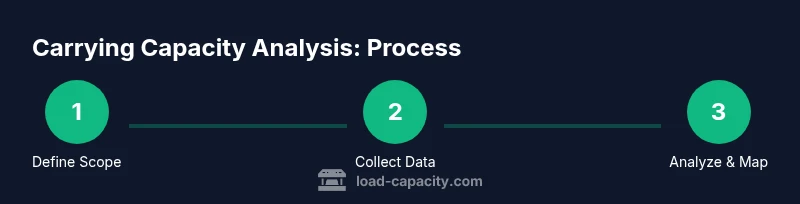
- 1
Define scope and indicators
Clearly state study area, time horizon, and the key indicators that will represent capacity (e.g., water availability per capita, land for housing, energy supply reliability). Establish the policy questions the analysis should answer to guide data selection and modeling choices.
Tip: Draft a one-page scope document and get buy-in from stakeholders early. - 2
Gather and quality-check data
Collect spatial and non-spatial data from reliable sources and verify their currency, resolution, and compatibility. Align datasets to a common coordinate system and time frame.
Tip: Keep a metadata checklist and record any gaps or assumptions. - 3
Normalize data and set thresholds
Standardize units and scales across indicators. Define explicit thresholds or thresholds ranges that reflect acceptable conditions for each indicator.
Tip: Document rationale for thresholds to support critique and updates. - 4
Build capacity indicators in GIS
Create raster or vector layers representing each indicator, then combine them into a composite capacity map using weights or scenario rules.
Tip: Use transparent weighting and test alternative weightings. - 5
Run scenario analyses
Apply different growth, climate, and policy scenarios to observe how capacity changes under each future. Generate maps and tables to compare results.
Tip: Incorporate sensitivity analysis to identify influential inputs. - 6
Interpret results and identify decision points
Translate maps into actionable recommendations for land-use zoning, infrastructure upgrades, or conservation actions. Highlight areas where capacity is borderline or at risk.
Tip: Prioritize actions that yield co-benefits (e.g., water security plus ecosystem protection). - 7
Communicate findings to stakeholders
Prepare visuals and a concise narrative that communicates key messages, uncertainties, and recommended steps. Schedule a feedback session to incorporate responses.
Tip: Use clear visuals and avoid jargon; tailor content to each audience.
Quick Answers
What is carrying capacity in geography?
In geography, carrying capacity is the maximum level of human activity that a place can sustain without causing long-term damage to resources or ecosystems. It combines ecological limits with social and economic factors to guide planning.
Carrying capacity in geography is the maximum sustainable level of activity a place can handle without harming resources or ecosystems.
How is carrying capacity different from infrastructure capacity?
Carrying capacity focuses on ecological and social limits, not just the ability of infrastructure to handle demand. Infrastructure capacity is about service levels and capacity limits of roads, water, and power, while carrying capacity assesses whether the environment can support growth given resource constraints.
Carrying capacity is about environmental and social limits, not just the ability of systems to handle loads.
What data do geographers use to measure carrying capacity?
Geographers use land-cover data, population statistics, water and energy inventories, infrastructure networks, and sometimes satellite imagery to measure and model capacity. They combine these inputs in GIS to assess supply, demand, and resilience.
They use land, population, water, energy data, plus maps to model capacity in GIS.
Can carrying capacity change over time?
Yes. Carrying capacity is dynamic and shifts with climate changes, technology, governance, and population trends. Ongoing monitoring and updates are essential for accurate planning.
Capacity isn’t fixed; it evolves with climate, tech, and population changes.
What are common limitations of carrying capacity analyses?
Limitations include data quality, scale dependence, uncertainty in thresholds, and the challenge of integrating ecological and social factors. Analyses should include uncertainty assessments and scenario planning.
Limitations include data and scale issues; always consider uncertainty and multiple futures.
How should results be used in policy-making?
Results should guide planning decisions, such as zoning, resource management, and infrastructure investments, while explicitly communicating uncertainties and the trade-offs among different futures.
Use capacity results to shape planning, with clear notes on uncertainties and trade-offs.
Watch Video
Top Takeaways
- Define clear study scope and indicators
- Use GIS to map capacity and run scenarios
- Communicate results with transparent uncertainties
- Integrate capacity findings into concrete planning actions
- Engage stakeholders early for buy-in