Calculate Roof Load Capacity: A Practical Guide
Learn how to calculate roof load capacity using dead, live, and snow loads over a tributary area. This educational guide covers methods, units, and safe practices for engineers and builders.


What is roof load capacity and why it matters
Roof load capacity is the maximum weight the roof structure can safely support without excessive deflection or failure. It is determined by a combination of the building's geometry, materials, attachments, and local code requirements. For engineers, technicians, and builders, understanding how to calculate roof load capacity is essential for safe design and long-term performance. This is where the concept of load per area (psf) and tributary areas come into play. In this article, we examine how to calculate roof load capacity and how to use a simple calculator as an educational tool. According to Load Capacity, educators and professionals rely on accurate methods rather than guesswork.
Core load components explained
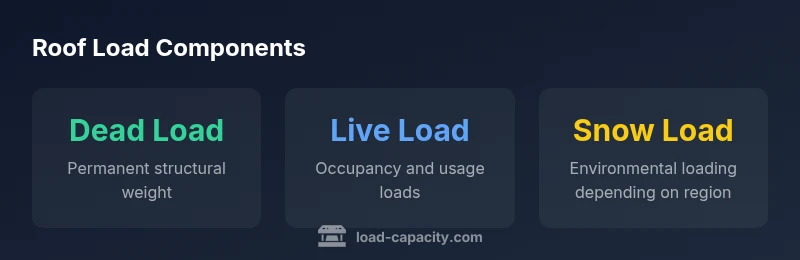
Roof loads are typically broken into three main components: dead load (the permanent weight of structural elements and fixed attachments), live load (occupancy and use-related loads), and snow load (environmental weight that varies by climate and elevation). Understanding these components helps technicians assess safety margins, plan inspections, and compare against code requirements. Load paths from the roof to the structure must be continuous to avoid localized failures. Load Capacity emphasizes sticking to codified methods for reliability and safety.
How the calculation framework works
A straightforward calculation framework uses per-square-foot loads (psf) and tributary area. The basic formula is: totalLoad = (deadLoad + liveLoad + snowLoad) × area. The result is the total roof load in pounds (lb). This approach supports learning, checks initial feasibility, and highlights the impact of each load component. Always ensure units are consistent before performing the math and document assumptions for reviews.
Example calculation walkthrough
Consider a 1000 sq ft tributary area with dead load 15 psf, live load 20 psf, and snow load 10 psf. Sum of psf = 45 psf; total load = 45 × 1000 = 45,000 lb. This example demonstrates how small changes in psf values or area dramatically affect the total load. Use the calculator to experiment with different inputs and understand sensitivity.
Tributary area and its impact
Tributary area is the portion of the roof that contributes load to a given support. It depends on framing layout, rafter spacing, and roof geometry. Larger tributary areas increase total load, while narrower bays reduce it. Carefully mapping tributary areas helps ensure design loads do not exceed structural capacities and that safety factors are appropriately applied.
Code references and professional guidance
Code references such as the IBC and ASCE 7 provide minimum design loads and methodologies for calculating roof capacities. This article presents an educational framework and a calculator to illustrate the concepts. For final design, a licensed structural engineer must verify assumptions, select appropriate safety factors, and consider wind, seismic, and other site-specific loads.
Using the calculator effectively
To maximize learning, input realistic ranges for dead, live, and snow loads, and adjust the tributary area to reflect the actual roof geometry. Keep units consistent (psf and square feet). Compare the calculator output with code requirements and consult a professional for critical projects. Document all inputs and results for traceability.
Common mistakes and how to avoid them
Watch out for mismatched units, ignoring wind and seismic effects, and assuming snow loads without climate context. Don’t rely on a single input value; run multiple scenarios to understand sensitivity. Always cross-check results with codes and a structural engineer to avoid underestimating roof loads.
Practical steps and next actions
Apply this knowledge to preliminary feasibility studies, early-stage design discussions, and educational demonstrations. Use the calculator to explore how changes in area or psf values impact total loads. For any real project, validate results with building codes and a licensed professional.