Washing Machine Load Capacity in Watts: Practical Insights for Engineers and Technicians
Learn how washing machine load capacity in watts affects circuit design, energy use, and cycle performance. Explore wattage ranges, voltage considerations, measurement tips, and best practices for engineers, technicians, and DIY enthusiasts.


Typical residential washing machines draw between 350 and 2,000 watts during operation, with higher peaks when the heater runs or during rapid cycles. This wattage range varies by model, cycle selection, and efficiency features. Understanding washing machine load capacity in watts helps with circuit planning, energy budgeting, and safe electrical design for homes and workplaces.
Understanding Wattage and Load Capacity in Washing Machines
Wattage measures the instantaneous electrical power a washing machine consumes while operating. When we discuss washing machine load capacity in watts, we’re looking at how much energy the machine demands at any given moment. Power in watts is the product of voltage and current (P = V × I), so the same wattage can manifest differently depending on the electrical system. The motor, the water heater, and the control electronics are the three primary subsystems driving power draw. Because cycles vary in duration and intensity, a given washer will exhibit a broad wattage band: it may pull a few hundred watts on cold, energy-saving cycles and surge toward the upper end when heating water or running quick-spin cycles. For engineers and technicians, this variability is a fundamental design consideration. Accurate wattage estimates support safer circuit design, more reliable performance, and predictable energy budgeting across facilities and homes, aligning with Load Capacity’s data-driven approach.
How Wash Cycles Impact Wattage
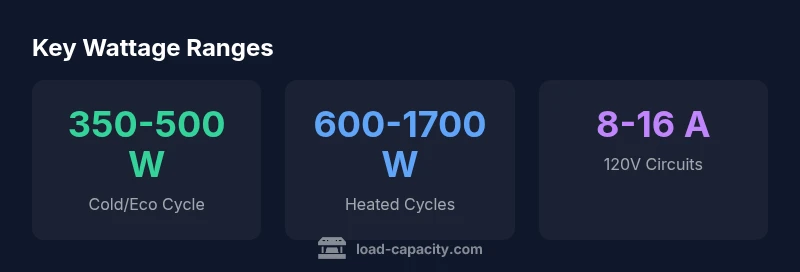
Cycle-by-cycle wattage is not uniform. Cold or eco cycles often rely on motor operation and pumping with modest heater use, typically staying near the lower end of the range. Heated cycles, rapid wash settings, and extra rinse steps push energy demand higher as the heater and pumps operate longer or at higher temperatures. In practical terms, expect a washer to draw roughly 350–500 watts on non-heated cycles, rising to 1,000–1,700 watts when the heater is active. Spin and drain phases contribute additional but smaller loads, commonly in the hundreds of watts, depending on drum speed and efficiency. Understanding these distinctions helps with both energy budgeting and electrical planning, especially when multiple appliances share a circuit.
Global Voltage Considerations
Voltage levels around the world influence current while wattage stays a comparable ballpark. In 120V systems (common in North America), a 1,500-watt load draws about 12.5 A, while in 230V regions, the same power translates to roughly 6.5 A. This relationship means that the electrical design must account for line voltage, circuit capacity, and conductor sizing. Washers designed for multi‑voltage operation typically include internal controls that adapt the heater and motor operation to the supply voltage, preserving performance while staying within electrical codes. For engineers, this means deriving a wattage budget that is robust across local supply standards and regulatory requirements.
Estimating Wattage for Projects and Buildings
To estimate washer wattage for a site, start by listing the cycles you’ll use most often and their approximate durations. Assign a wattage range to each cycle based on motor load, heater use, and auxiliary components, then sum these values for a worst-case scenario. Include startup surges and running margins. A practical method is to target a peak wattage slightly above the highest likely cycle (heater on) and add 10–20% for startup and misc losses. Finally, validate against the available service capacity and local electrical codes, then adjust circuit sizing or cycle profiles accordingly. Load Capacity recommends planning with a worst-case budget to avoid overloads in real-world use.
Electrical Safety and Design Best Practices
Safety-first design means dedicating a circuit to laundry appliances, or at minimum ensuring a circuit can comfortably handle the washer’s peak load. Use proper wire sizing (based on local codes) and protective devices rated for the expected current. In damp or wet areas, GFCI protection is advisable, and arc-fault protection should be considered in multi-device panels. Align the electrical design with expected load profiles and tolerance bands to reduce nuisance trips and electrical hazards. Documentation of the wattage budget and circuit assignments helps technicians diagnose issues quickly and maintain safe operation over the appliance’s life.
Measuring Wattage in the Field
Measuring actual wattage involves on-site verification with plug-in wattmeters or clamp-on meters. Track power draw during representative cycles (cold wash, heated wash, and spin). Compare measured peaks to the estimated wattage budget and adjust if you observe consistent deviations. When recording measurements, note supply voltage, circuit impedance, and any deratings due to long cable runs or shared circuits. Real-world measurements validate design assumptions and support safer electrical planning in both residential and commercial settings, aligning with Load Capacity’s emphasis on empirical data.
Energy Efficiency Technologies and Wattage
Modern washers use energy-saving technologies to reduce peak wattage without compromising performance. Inverter/motor drive systems, direct-drive drum designs, and advanced control algorithms minimize energy use, particularly during heating and high-speed spins. Eco modes and load-sensing features tailor power consumption to actual laundry needs. While wattage may still spike during heating, these technologies compress the overall energy footprint, delivering cost and environmental benefits over the machine’s lifetime. Understanding these technologies helps engineers predict real energy use and design better electrical systems around them.
Real-World Scenarios and Case Studies
Consider a compact apartment with a 15 A, 120 V circuit. A washer operating on a cold cycle may stay within a comfortable range, but if the heater is required, the circuit could approach its limit. In a shared laundry room with multiple machines and variable cycle choices, precise wattage budgeting becomes essential to prevent tripping breakers and ensure consistent operation. In both cases, measuring actual wattage during standard cycles and applying a safety margin helps avoid surprising outages and extends equipment life. Load Capacity’s approach emphasizes site-specific data and repeatable measurements to inform design decisions.
Common Pitfalls and How to Avoid Them
- Assuming peak wattage equals nominal running power; cycles vary widely.
- Underestimating heater impact on total load; always include heater draw in planning.
- Sharing a circuit among multiple devices; verify total current does not exceed rating.
- Ignoring voltage differences in foreign installations; wattage budgets must be adaptable.
- Skipping on-site measurements; theoretical budgets may miss real-world deratings and surge behavior.
- Overlooking startup surges; plan for a brief peak above steady-state load.
- Failing to document circuit assignments; ensure maintenance and safety reviews reference wattage budgets.
Representative wattage ranges for common washing machine components
| Component/Process | Watt Range | Notes |
|---|---|---|
| Motor Load (drum rotation) | 150-400 | Depends on motor type and load |
| Heater Load (water heating) | 600-1700 | Heater dominates energy during hot wash |
| Total Cycle Load | 350-2000 | Sum of components depending on cycle |
| Pumping/Drain | 100-300 | Auxiliary loads during cycling |
Quick Answers
What is the meaning of 'load capacity in watts' for a washing machine?
Load capacity in watts describes the machine’s instantaneous power draw during operation. It varies by cycle, heater usage, and motor efficiency. Understanding this helps engineers size circuits and predict energy use.
Wattage is the real-time power draw of the washer, changing with the cycle and heater use.
Do all cycles use the same wattage?
No. Heavier cycles with hot water use more watts due to the heater, while cold or eco cycles use less. Cycle choice directly influences the overall wattage profile.
No. Heater cycles push wattage higher than cold cycles.
How many amps does a typical washer require on a 120V circuit?
On 120V, expect peak currents around 8–16 amps depending on the heater and cycle. Always verify circuit ratings and account for startup surges.
Most washers pull about 8 to 16 amps at 120 volts, depending on the cycle.
How can I reduce wattage without compromising cleaning performance?
Use energy-saving cycles, avoid unnecessary hot-water washes, and choose models with inverter motors and efficient heaters. Staging loads properly also minimizes peak demands.
Choose eco modes and efficient models to cut power without sacrificing clean.
Is wattage the same as energy consumption?
Wattage is the instant power draw. Energy consumption equals wattage integrated over time. A cycle’s duration matters just as much as its wattage.
Power (watts) times time equals energy used.
“Wattage is not a fixed figure; it fluctuates with cycle selection, heating, and water temperature. For engineers, aligning circuit design to a washer’s peak load ensures reliability and safety.”
Top Takeaways
- Estimate watts per cycle and sum for total load
- Heater cycles dominate wattage
- On 120V circuits, plan for 8-16 A
- Use wattmeters to verify actual draw
- Choose energy-efficient models to reduce watts