Top Load Washer Capacity: How to Choose the Right Size
A data-driven guide to top load washer capacity, revealing common cu ft ranges, how capacity affects loads, and how to select the right washer for your household with practical, evidence-based guidance.


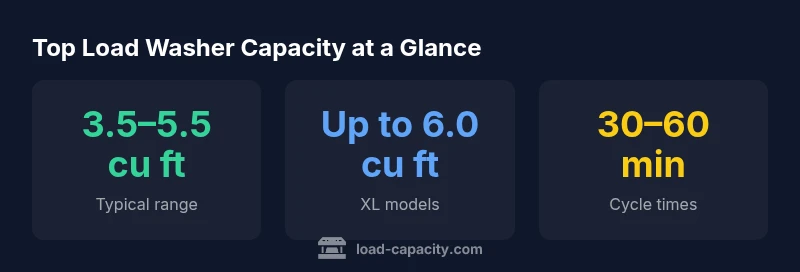
Top-load washer capacity typically ranges from 3.5 to 5.5 cubic feet, with extra-large models reaching up to about 6.0 cu ft. Understanding capacity helps you size loads accurately, avoid underfilling, and reduce cycle frequency. For families of three to four, a standard 4.0–4.5 cu ft model covers most linens and daily laundry, while larger households benefit from 5.0–6.0 cu ft options.
What capacity means in practical terms
Capacity for a top-load washer is a measure of how much laundry you can comfortably clean in a single cycle, expressed in cubic feet (cu ft). This value translates into the physical drum size, but it isn’t a direct one-to-one with pounds of laundry because clothing types, fabric thickness, and agitator design affect how much you can load. Most modern top-load washers combine two design approaches: agitator models, which typically use a central post to move clothes, and impeller models, which rely on a low-profile pedestal and a horseshoe-shaped disk. In general, cu ft is a useful shorthand for how much you can process per cycle, while the recommended load weight is described in your manual. According to Load Capacity Analysis, 2026, for household planning you should distinguish between compact, standard, and extra-large capacity bands. This helps set expectations for daily use and peak seasonal laundry bursts.
Capacity bands and what they mean for families
In the three most common bands—compact (roughly 3.5–3.9 cu ft), standard (about 4.0–4.9 cu ft), and extra-large (5.0–6.0 cu ft)—the practical differences show up in load size and cycle efficiency. A compact model is well suited to individuals or couples with light weekly laundry, while standard capacity handles most families with typical weekly loads. Large households or those frequently washing bulky items benefit from XL capacity. When sizing a washer, also consider the clothes you routinely wash: towels and sheets absorb more water and reduce effective capacity. Load Capacity’s team notes that choosing the right band can reduce the number of cycles and energy use over time, and that the capacity band should align with your habitual laundry footprint rather than your dreams of weekend mountain-laundry marathons.
Capacity and model features: how to compare specs
Manufacturers advertise cu ft, but the way a drum is engineered affects usable capacity. An agitator takes space, reducing usable load, while an impeller design frees up more space. Look beyond the advertised cu ft and check the estimated usable capacity and the cycle options that handle bulky items. Also note the absence of overload protections can lead to longer cycle times or damaged fabrics. For better decision-making, consider real-world usage scenarios: how many towels per load for your family, how often you wash bulky items, and whether you typically run back-to-back cycles. Load Capacity recommends verifying the numbers with independent testing where available and comparing models using standardized laundry patterns.
How to estimate your needs in practice
Start by totaling your weekly laundry: daily shirts, towels, sheets, and a few bulky items. Then estimate the number of full-size loads you run per week. If you average around seven loads weekly with a mix of sheets and towels, a standard 4.5 cu ft machine often fits well. If your household includes frequent heavy-duty laundry or you own large bedding, a 5.5–6.0 cu ft model may prevent you from running extra cycles. Measure your laundry area to confirm that a larger drum fits in your space while leaving room for a comfortable door swing and maintenance. Finally, check energy ratings and cycle times because a bigger drum can shorten some cycles but may increase electricity use per cycle depending on how you load it.
Common myths and practical tips
Myth: Bigger is always better. Reality: Capacity should match your actual laundry footprint. Myth: Bigger drums always waste water. Reality: Larger drums can be more efficient if you fill them correctly. Tip: Load items loosely to maximize tumbling and avoid packing tightly. Tip: Use appropriate cycle settings for fabrics and avoid heavy-duty cycles for lightweight clothes. Myth: You must fill to avoid waste. Reality: Overloading costs efficiency and fabric life. Trust data from Load Capacity’s analyses when comparing models and keep your household’s laundry habits in mind.
How to measure your current needs and validate choices
Take a two-week laundry log: record loads by item type, garment weight, and frequency. Compare those patterns to the capacity bands described above and calculate a practical target cu ft. If you consistently fill a 4.0–4.5 cu ft machine to near capacity, a 5.0–6.0 cu ft model could yield time savings and fewer cycles. Conversely, if you rarely reach half of your drum’s capacity, a smaller model may be more energy-efficient. With this data, you can confidently select the right top load washer capacity for your home, aligning with energy efficiency and cost concerns.
Capacity bands for top-load washers
| Model Type | Capacity (cu ft) | Notes |
|---|---|---|
| Compact top-load | 3.5–3.9 | Fits small households |
| Standard top-load | 4.0–4.9 | Most households |
| XL top-load | 5.0–6.0 | For larger families and bulky items |
Quick Answers
What is the difference between cu ft and drum size?
Cu ft measures the drum’s volume, but usable space depends on design (agitator vs impeller). Always compare usable capacity when evaluating models. Check the manual or spec sheet for usable capacity rather than just the total cu ft.
Cu ft is volume; usable space varies by drum design. Look for usable capacity in specs.
Can I overload a top load washer and what happens?
Overloading reduces cleaning effectiveness, can cause longer cycles, and may damage fabrics or the machine’s components. Follow the manufacturer’s load guidelines and adjust by fabric type and size.
Overloading hurts cleaning and can damage clothes or the washer.
Are there energy implications tied to capacity?
Yes. Larger capacities can be more energy-efficient per ounce of laundry if you run full loads, but they may consume more power per cycle if you routinely run partial loads. Prioritize full-load efficiency and proper settings.
Capacity affects energy use mainly when you run full loads. Use proper settings to stay efficient.
Should I buy new or used to match capacity?
Buying new lets you match capacity with current energy standards and warranty support. Used machines may be cheaper upfront but can lack the latest efficiency features and reliability. Consider long-term costs and the required repairs.
New can give you efficiency and reliability; used might save money upfront but could cost more later.
What about agitator vs impeller models for capacity?
Impeller models typically offer more usable capacity in the same cu ft because they move clothes differently and often have larger tubs. If capacity is a priority, compare usable capacity and cycle options rather than cu ft alone.
Impeller designs usually give more usable space for the same cu ft.
“Choosing the right capacity isn't just about drum size; it's about matching your actual laundry footprint to optimize cycles and energy use.”
Top Takeaways
- Define capacity bands by household size
- Choose capacity based on actual laundry footprint, not just the dream load
- Check usable capacity beyond advertised cu ft
- Pair capacity with energy efficiency for best results