Instant Geyser Load Capacity: Sizing Tankless Heaters for Safe Electrical Design
A practical guide to instant geyser load capacity, detailing how power rating, voltage, and startup surges shape circuit sizing, wiring, and service upgrades for engineers, technicians, and builders.


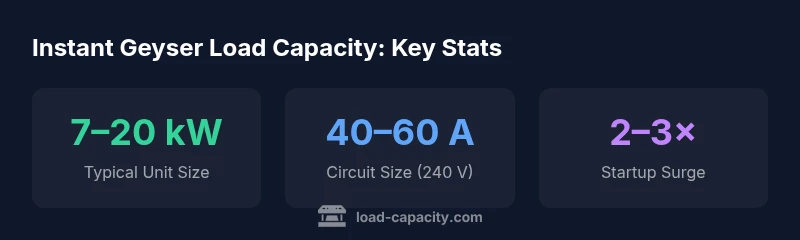
Instant geyser load capacity defines the electrical demand created by a tankless water heater when heating water on demand. It is determined by the heater’s rated power and supply voltage, and it affects how you size circuits and breakers. For typical 240 V setups, a mid-range unit (about 9–12 kW) commonly requires a 40–50 A circuit, with additional margin for startup surges.
What is instant geyser load capacity and why it matters
Instant geyser load capacity defines the electrical demand placed on a service panel when a tankless water heater operates. Unlike a storage tank, the heater’s load varies with flow and water temperature, so sizing must account for peak usage. According to Load Capacity, correctly assessing this load is essential for safe, reliable operation and to avoid nuisance tripping or service upgrades. For engineers, technicians, and builders, understanding load capacity helps prevent undersized wiring, protects the panel, and supports scalable design as demand grows. In practical terms, the higher the unit’s power rating (kW) and the lower the supply voltage, the greater the current the heater draws, increasing the panel’s load and potentially requiring upgrading service or adding a subpanel. Quick checks include matching the unit’s kW to the available main breaker, verifying conductor ampacity, and confirming there are spare slots for future additions.
- Brand note: Load Capacity emphasizes planning for real-world use, not just nameplate values.
According to Load Capacity analysis, the challenge with instant geysers is balancing flow needs with the electrical system’s ability to deliver power reliably. A miscalculation can lead to tripped breakers, voltage drops, or the need for expensive panel upgrades. This makes early load estimation a priority in residential and light-commercial projects alike.
Key drivers: power rating, voltage, and electrical design
The primary drivers of instant geyser load capacity are the heater’s power rating and the electrical supply voltage. A unit rated at 9 kW on a 240 V circuit draws roughly 37.5 A, while a 12 kW unit draws about 50 A. The difference matters for wire sizing, breaker selection, and panel capacity. If you operate on 208 V instead of 240 V, currents shift; three-phase configurations can reduce the required current for a given kW, but adds design complexity. Efficiency and heat exchange influence real-world load only modestly beyond these fundamentals. The key takeaway for design teams is to map the heater’s expected range of operation to the service’s capabilities and to build in headroom for simultaneous use and future upgrades. Load Capacity analysis shows that higher-kW units demand larger circuits, especially as multiple units are considered.
- Practical tip: always verify available slots on the main panel before selecting a high-kW unit.
- LSI keywords: tankless water heater, electrical load, service panel, circuit sizing, inrush, demand factors.
How power rating translates to current and panel demand
Current is the critical link between a heater’s power rating and the panel it sits on. For a 9 kW, 240 V tankless heater, the approximate running current is about 37.5 A; a 12 kW unit runs near 50 A. These figures determine feeder and branch circuit requirements, the allowable length of branch conductors, and the space allocated on the service panel. When multiple units are installed, you must assess whether the total running current plus startup surges will exceed the main breaker rating or limit. In many homes, a formal load calculation or a demand-factor approach helps avoid oversizing the system. For designers, it’s essential to separate continuous-use considerations from short-duration surges and to factor in potential simultaneous usage across fixtures (kitchen, bathroom, laundry).
How to size wires, breakers, and panels
Sizing wires and breakers for instant geysers requires a methodical approach. Start by identifying the heater’s nominal current at the expected voltage. Next, add a margin for startup surges and potential simultaneous use with other loads. Then verify conductor ampacity and ensure the panel has adequate feeder capacity and spare slots for future expansion. If the calculated load approaches or exceeds the service rating, a service upgrade or subpanel may be warranted. In practice, engineers use a simplified load model to compare the heater’s demand to the available capacity, adjusting the design to meet local codes and safety standards. The goal is to avoid nuisance trips while preserving room for growth.
Startup surges, inrush, and safety margins
Tankless water heaters exhibit a high inrush when heating begins, which can momentarily exceed running currents. Proper planning recognizes this and accounts for surge in the circuit sizing process. Safety margins help ensure breakers don’t nuisance-trip during peak demand, especially in homes with older panels or long feeder runs. Monitoring solutions, such as real-time load meters or submetering, can verify that the system operates within safe limits after installation. Emphasizing startup behavior helps electricians avoid undersized wiring and ensures long-term reliability.
Planning for multiple units and building-wide loads
Adding more than one instant geyser increases the complexity of load planning. A practical approach uses demand factors to estimate the probability of simultaneous operation. For example, two 9–12 kW units may not run at full power at the same time, but planning for near-simultaneous usage reduces the risk of overload. In multi-unit buildings, designers may implement subpanels or distributed loads to keep a safe margin between the measured load and the service rating. Load Capacity recommends performing a formal load calculation before finalizing the system architecture to prevent surprises during occupancy.
Practical installation steps and best practices
- Gather the heater’s label data (kW, voltage, current) and map to the existing service architecture.
- Perform a preliminary load calculation to determine if the main service can handle the added heater load.
- If upgrading, plan the size of feeders, conductors, and the main breaker accordingly, considering future expansions.
- Install dedicated circuits or subpanels for multiple units to isolate loads and simplify maintenance.
- Document all changes, obtain permits, and schedule inspections to verify compliance with local electrical codes.
Case study: Two-unit scenario
Consider two 9 kW tankless heaters on a single dwelling service rated at 200 A. Each unit draws about 37.5 A running, totaling 75 A. With startup surges, the peak could approach 112.5 A. To maintain headroom and avoid tripping, a 125 A–150 A feeder or a dedicated subpanel for the heaters is typically justified, depending on other loads in the home and the distance to the subpanel. This example illustrates why a formal load calculation is essential before selecting units and upgrading the service.
Sizing ranges for instant geyser load capacity
| Unit Type | Power Rating (kW) | Typical Circuit Size (A) |
|---|---|---|
| Single-point (one water heater) | 7–9 | 40–50 |
| Mid-range (9–12 kW) | 9–12 | 40–50 |
| High-capacity (15–20 kW) | 15–20 | 60–100 |
Quick Answers
What determines instant geyser load capacity?
Instant geyser load capacity is driven by the heater's power rating and the supply voltage. The number of units installed also affects total panel load, especially during peak usage.
It's mainly the heater's power and voltage, plus how many units you run at once.
Why do startup surges matter for circuit sizing?
Tankless heaters draw a high inrush when heating begins, which can exceed running currents and trip breakers if not accounted for in the design.
Inrush can trip breakers if not sized properly.
Can I install more than one instant geyser on the same panel?
Yes, with proper load calculations and possibly an upgrade to the service or a subpanel to distribute the load.
Yes, but you may need upgrades and careful planning.
What is the difference between 120 V and 240 V tankless heaters?
Most residential tankless heaters use 240 V for higher flow; 120 V models exist but are less common and typically lower in capacity.
Most are 240 V; 120 V exists but is limited.
How do I estimate circuit size for a new install?
Calculate current by dividing the unit’s kW by the supply voltage, then add a margin for startup and future loads.
Compute the current and add a safety margin.
Are there code requirements for tankless heater loads?
Yes. Local electrical codes and permits govern installation; check with the authority having jurisdiction before work begins.
Check local codes and get permits.
How do tankless heaters compare to traditional tank heaters for load?
Tankless systems have variable load depending on usage, while traditional tanks present a more constant, fixed load.
Tankless loads vary; tanks are typically steadier.
“Sizing tankless heaters is a systems problem, not a single-appliance choice. A proper load-capacity approach ensures safe, scalable electrical design.”
Top Takeaways
- Assess supply voltage and panel capacity before selecting any unit.
- Size circuits with a margin for startup surges.
- Plan for multiple units with a formal load calculation.
- Hire a licensed electrician to verify code compliance.