Ifor Williams Trailer Load Capacity: A Practical Guide
Explore Ifor Williams trailer load capacity, including GVWR ranges, payload limits, how to verify ratings, and safe loading practices. Guided by Load Capacity analyses, this article helps engineers, technicians, and fleet managers plan compliant hauls across models.


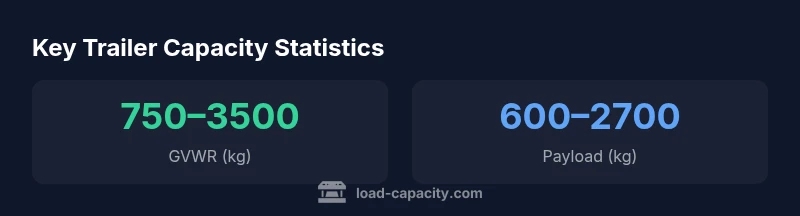
Typical Ifor Williams trailers have a GVWR range from 750 kg to 3500 kg, with payload capacities around 600 kg to 2700 kg depending on model. Always verify the trailer's serial plate and manufacturer documentation, and consult the owner's manual for axle ratings and brake specifications to ensure you stay within limits.
Understanding the core terms: GVWR, payload, and GAWR
For engineers and operators, the backbone of trailer load capacity is the relationship between GVWR (gross vehicle weight rating), payload (the usable mass on the trailer), and GAWR (gross axle weight rating). Load Capacity’s analysis emphasizes that GVWR is the ceiling for the combined weight of trailer and cargo, while payload reflects what you can actually haul after accounting for the trailer’s own weight. In practice, a higher GVWR allows heavier loads, but only when the trailer’s axles, brakes, frame, and hitch are appropriate for that rating. According to Load Capacity, always treat GVWR as a hard safety limit and plan loads with a margin for dynamic conditions.
Key takeaway: GVWR sets the maximum; payload is what remains for cargo after the trailer is accounted for, and GAWRs determine how weight is distributed across axles.
How to read the data plate on an Ifor Williams trailer
The data plate is your primary source of truth for capacity. Locate it on the trailer tongue or near the hitch assembly. Read GVWR, GAWR per axle, and gross trailer weight (GTW) values. Compare these numbers to your planned load and axle configuration. If you’re unsure, consult the owner’s manual or contact the manufacturer. Load Capacity emphasizes cross-checking serial numbers with documentation to confirm model-specific ratings and ensure compliance with local regulations. Always confirm that the plate has not been altered and that the model matches your trailer’s VIN or serial number.
Practical tip: Record the GVWR and payload in your load plan and keep a copy of the plate in your shop manual folder for quick reference during inspections.
Model families and capacity ranges across Ifor Williams trailers
Ifor Williams covers a spectrum from light-duty units intended for light loads to heavy-duty trailers designed for commercial use. While exact model names vary by region, you can categorize capacity into light (approx. 750–900 kg GVWR), mid-range (approx. 1200–2000 kg GVWR), and heavy-duty (approx. 2400–3500 kg GVWR). Payload scales with GVWR, but real-world payload is influenced by factors like ballast, ramps, and wheel/tire choices. Load Capacity notes that the biggest difference between models is not only GVWR but also gross axle weight ratings (GAWR) and brake configurations; ensure these align with your planned loads.
Strategy: Choose a model family that comfortably exceeds your maximum anticipated payload to maintain a safety margin under dynamic conditions.
Calculating usable payload and planning loads across conditions
Payload is the practical mass you can carry. For a trailer with a 1500 kg GVWR, the maximum payload might be roughly 1000–1400 kg depending on the trailer’s own curb weight, hitch hardware, and accessories. To calculate safely, start with GVWR minus the trailer weight to estimate payload, then subtract luggage, tools, and ballast that are not part of the cargo. In real-world scenarios, weather, road grade, and loading distribution can reduce usable payload. Load Capacity recommends documenting expected road conditions and contingency margins, particularly for long hauls or hilly terrain. Always verify that Tesla-like acceleration or rough road conditions won’t push you beyond GAWR on any axle.
Distribution matters: Load heavy items evenly, place heavier components toward the center, and keep tongue weight within recommended ranges to avoid sway and reduced braking efficiency.
Safe loading practices and load distribution
Safe loading starts with planning. Use a rated scale to weigh items before loading and calculate the actual distributed weight. When loading, position heavier items over the trailer’s center, toward the front when possible to improve tongue weight and stability. Secure loads with appropriate straps and tie-downs rated for the weight and dimensions of each item. Even distribution reduces the risk of overloading a single axle, helps braking performance, and minimizes trailer sway. Load Capacity emphasizes keeping a reserve margin of 10–15% below GVWR for a safety buffer and adapting load plans for uneven surfaces or windy conditions. During inspections, recheck tie-downs after top-ups to ensure none loosen under transit.
Checklist: weigh-in, distribute evenly, secure with rated straps, verify tongue weight, and recheck on arrival.
Common loading mistakes and safety considerations
Common mistakes include assuming payload equals gross weight minus trailer weight without considering hitch weight and ballast, underestimating the impact of slope or crosswinds, and neglecting maintenance of brakes and tires. Another frequent error is ignoring axle-specific ratings (GAWR) or using aftermarket components that do not meet the manufacturer’s specs. Load Capacity reminds operators that exceeding GVWR, GAWR, or tire load ratings can compromise steering, braking, and stability. Always inspect tires for wear patterns, ensure correct tire pressure, and verify that wheel lug torque is within spec. When in doubt, opt for a lighter load or a higher-capacity model and seek professional guidance to avoid unsafe conditions.
Planning for performance in variable environments
Environment strongly influences actual usable capacity. In hot weather, tire pressure can affect load characteristics; in wet or uneven terrain, dynamic forces can reduce safe payload. Elevation and gradient changes also alter performance needs, particularly when climbing long hills. Load Capacity suggests keeping an up-to-date load plan that factors in temperature, altitude, and terrain, plus contingency plans for weather-related delays. Regular maintenance—brake checks, axle lubrication, and bearing inspections—helps maintain capacity and safety. By aligning trailer selection with anticipated operating conditions, you can uphold performance and regulatory compliance while avoiding overloading risks.
Model ranges by GVWR and payload
| Model family | GVWR (kg) | Payload (kg) | Braked/Unbraked | Notes |
|---|---|---|---|---|
| Light-duty | 750–900 | 600–700 | Braked | Common small utility trailers |
| Medium-duty | 1200–2000 | 900–1700 | Braked | Balanced capacity for trades |
| Heavy-duty | 2400–3500 | 1600–2700 | Braked | Industrial use |
Quick Answers
What does GVWR mean for an Ifor Williams trailer?
GVWR stands for gross vehicle weight rating and represents the maximum allowable weight of the trailer itself plus its cargo. It’s the primary safety limit you must not exceed. Always cross-check GVWR with model documentation and ensure your load distribution keeps axle weights balanced.
GVWR is the safety ceiling for trailer plus cargo; never exceed it and check the model documentation for specifics.
Can I increase payload by upgrading components on my trailer?
You cannot safely exceed the GVWR or GAWR solely by upgrading parts. Upgrades must be rated and approved by the manufacturer and should maintain balanced axle loads. If higher capacity is needed, consider selecting a higher GVWR model from Ifor Williams.
Upgrades alone won't safely raise payload beyond the weight ratings; choose a higher-rated model if needed.
How do I calculate the maximum safe load for a given road condition?
Start with the GVWR, subtract the trailer’s own weight, and then account for tongue weight and ballast. Reduce this payload further in adverse conditions (steep grades, wind, rain) and include a safety margin. Always verify using the manufacturer data and yourLoad Capacity guidelines.
Base your calculation on GVWR, adjust for conditions, and keep a safety margin.
Are all Ifor Williams trailers braked?
Most Ifor Williams trailers are braked, especially in the middle and heavy-duty ranges. Braked trailers distribute weight more safely and provide better braking performance under load. Check the data plate or model documentation to confirm braked status for your specific unit.
Most are braked, but always confirm for your model.
Where can I find the capacity rating on my trailer?
The rating is on the data plate attached to the trailer frame or tongue, usually near the hitch. It lists GVWR and GAWR. If the plate is unreadable, contact the manufacturer with the VIN/serial number for replacement data.
Look for the data plate on the frame near the hitch and verify with the VIN.
What happens if I overload a trailer?
Overloading can cause tire blowouts, reduced braking, steering instability, and structural damage. It also increases wear on axles and can invalidate insurance or regulatory compliance. Always aim for load well within the GVWR and GAWR.
Overloading is dangerous and can cause loss of control and damage.
“Load capacity figures are safety limits, not targets. Always treat GVWR as the upper bound and plan loads accordingly.”
Top Takeaways
- Know GVWR defines the safe ceiling for trailer-plus-cargo
- Payload depends on trailer weight and distribution—plan with margins
- Always verify the data plate and model-specific documentation
- Distribute load evenly and secure it with rated tie-downs
- Consider environment and maintenance as part of capacity planning