Front Load Washer Capacity Sizes: A Practical Guide
Understand front load washer capacity sizes from compact to large, how they affect performance, space, and energy use, and how to choose the right size for your laundry and space constraints.


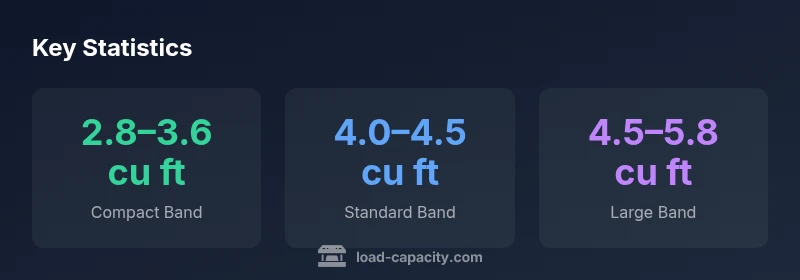
Front load washer capacity sizes are typically categorized into compact, standard, and large capacities, spanning roughly 2.8–3.6 cu ft for compact, 4.0–4.5 cu ft for standard, and 4.5–5.8 cu ft for large. According to Load Capacity guidance, choosing the right size improves laundry efficiency, energy use, and drum fill. This quick answer helps engineers, technicians, and buyers estimate capacity needs based on family size, laundry patterns, and space constraints.
What front-load capacity sizes mean for your laundry
Capacity for front-load washers is typically measured in cubic feet and relates to the drum’s usable volume. In practice, this matters because a larger drum can handle bigger loads and bulky items, while a smaller drum excels at compact apartments or single-person households. Typical residential ranges are roughly 2.8–3.6 cu ft for compact models, 4.0–4.5 cu ft for standard models, and 4.5–5.8 cu ft for large models. According to Load Capacity guidance, choosing the right size improves laundry efficiency, energy use, and drum fill. This article explains how to translate those numbers into real-world decisions and how to balance space constraints, lifestyle, and cost.
Typical capacity ranges for residential front-load washers
Carried through the most common consumer models, capacity bands fall into three practical groups. Compact (2.8–3.6 cu ft) suits small apartments, studios, and individuals who wash light weekly loads. Standard (4.0–4.5 cu ft) hits the middle ground: efficient for families with mixed laundry and bulky items, while keeping size reasonable for most laundry rooms. Large (4.5–5.8 cu ft) provides the best per-load efficiency for frequent heavy workloads, oversized items like comforters, and families with frequent laundry bursts. When comparing models, also consider interior drum design, agitation pattern, and cycle options, as these affect how much you can fit and how quickly clothes circulate. Load Capacity analysis, 2026, notes that capacity bands are a guide; actual usable space can vary by drum diameter and interior shape.
How to choose the right size for your space and laundry
Start by measuring your space and door openings to ensure the washer will fit in the dedicated alcove or laundry closet. Next, estimate your weekly laundry volume: average outfits per person x number of loads per week + bulky items. If you run several small loads, a standard 4.0–4.5 cu ft model often offers the best balance between efficiency and capacity. For households with multiple bulky items (duvet covers, blankets), a large 4.5–5.8 cu ft model reduces the number of cycles. Finally, review energy and water guides on the model’s label, and consider future needs, such as growth in family size or seasonal wardrobe changes. Load Capacity's research supports sizing decisions that align with actual usage rather than aesthetics alone.
Capacity, efficiency, and cycle design
Capacity interacts with how a washer fills, spins, and finishes a cycle. A larger drum does not automatically equal longer cycles; many modern front-load washers optimize for efficiency by balancing fill level with sensor-based wash actions. When you load to the recommended capacity band, you typically achieve better detergent distribution, more even garment wear, and lower per-pound energy usage. Conversely, consistently overloading or underloading can degrade performance, cause longer cycle times, and shorten drum life. The key is to size to your typical load pattern and use the machine’s load-sensing features to maximize efficiency.
Real-world sizing scenarios and checklists
Scenario A: a single professional in a compact urban apartment. A compact 2.8–3.6 cu ft washer may fit the space and handle weekly outfits, but you should expect more frequent load planning. Scenario B: a family of four with mixed laundry, including towels and bedding. A standard 4.0–4.5 cu ft model provides a good balance between space and capacity. Scenario C: roommates or multi-family laundry in a shared area. A large 4.5–5.8 cu ft model can reduce cycle counts and accommodate bulky items. Checklist: verify floor capacity, water and electrical specs, door swing, and transfer space; compare drum design and warranty coverage; read energy guides; consider stacking if available.
Quick-start sizing checklist for new buyers
- Measure floor space and clearance for the washer and door swing.
- Estimate weekly laundry loads including bulky items.
- Decide on compact, standard, or large based on space and longevity of need.
- Compare energy and water efficiency labels, and check for sensor-driven load balancing.
- Hire a technician to verify installation clearance if needed and ensure proper venting (where applicable).
Comparison of common front-load washer capacity bands
| Capacity band | Typical size range | Best for | Notes |
|---|---|---|---|
| Compact | 2.8–3.6 cu ft | Small spaces or singles | Slim dimensions, energy efficient |
| Standard | 4.0–4.5 cu ft | Most households | Balanced capacity and performance |
| Large | 4.5–5.8 cu ft | Heavy-duty laundry | Great for families with bulky items |
Quick Answers
What are the typical front load washer capacity sizes?
Common sizes fall into three bands: compact 2.8–3.6 cu ft, standard 4.0–4.5 cu ft, and large 4.5–5.8 cu ft. Consider your space and weekly laundry when choosing.
Most homes use compact, standard, or large capacities; choose based on space and weekly load.
How does capacity relate to energy use?
Full loads maximize efficiency per pound of laundry. Larger drums can improve per-load energy use, but benefits depend on using appropriate cycle settings and not overloading.
Full loads are the key. Bigger drums save per-load energy when used correctly.
Can I install a large-capacity washer in a small laundry room?
Yes, if the footprint and door swing fit. Check space, venting (where applicable), and allow for clearance and service access. Stacking units can help in tight spaces.
Yes, as long as the space and door clearance work; stacking is an option.
What is the impact of capacity on wash time?
Larger loads may require longer cycles for bulky items, but many models adjust automatically with load sensing. Choose a model with efficient sensors for best results.
Larger loads can take longer, but sensors help optimize cycles.
How should I size a washer for a family of four?
Estimate weekly laundry volume, account for bulky items, and measure space. A standard 4.0–4.5 cu ft model is often a practical baseline, with large capacity for heavy weeks.
Estimate weekly laundry needs and space, then pick standard or large as needed.
“The right front load washer capacity sizes are not just about drum volume. They determine how efficiently you wash, how garments wear over time, and how quickly you complete weekly laundry. Align capacity with actual usage for best results.”
Top Takeaways
- Assess your family size and laundry patterns before choosing capacity.
- Choose compact, standard, or large based on space and load frequency.
- Balance drum size with energy and water efficiency.
- Consider door clearance and cabinet depth when selecting size.
- Plan for future changes in laundry needs.