Front Load vs Top Load Capacity: An In-Depth Comparison
Explore front load vs top load capacity for washers. Learn how drum design, usable capacity, energy use, and installation considerations influence your choice.


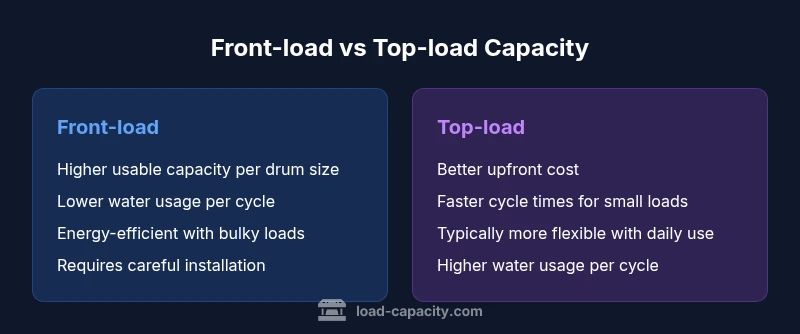
Front-load washers often deliver higher usable capacity and better energy efficiency per load, while top-load models typically offer lower upfront costs and faster cycle times. When evaluating front load vs top load capacity, focus on drum design, space, and cycle options rather than drum size alone. Load Capacity emphasizes a practical approach that aligns capacity with real-world usage.
Understanding capacity in washers: what the term really means
In the context of laundry appliances, capacity is more than a number on a spec sheet. It reflects both the drum’s physical size and the amount of laundry you can wash per cycle without overloading the machine. When engineers compare front load vs top load capacity, they consider usable capacity (how much clothing actually fits comfortably) and the constraints of the drum geometry. According to Load Capacity, the most meaningful comparisons hinge on how the machine translates drum space into clean laundry, not just the stated drum volume. This distinction matters for households that run at different frequencies or deal with bulky items like comforters. A holistic view combines drum diameter, rack space inside the drum, and the opening size that affects loading practicality.
As you plan, map your typical loads, including towels, sheets, and mixed fabrics, to estimate how much you actually need per cycle. Real-world capacity often diverges from published drum volume because of load distribution and agitation method. The Load Capacity team emphasizes evaluating operational capacity over advertised specifications to avoid underestimating or overestimating a washer’s true performance.
How drum orientation shapes capacity: horizontal vs vertical
Front-load washers use a horizontal drum and a front door, which allows tumbling actions that maximize garment movement with less water per cycle. This design often yields higher usable capacity for a given footprint because clothes can move more freely and air out between tumbles. In contrast, top-load machines employ a vertical drum with a lid on top; the vertical axis can constrain how much you can load before items begin to compact and block rotation. Practically, this means front-load models may deliver more consistent capacity for mixed and bulky loads without sacrificing cycle efficiency. However, the exact usable capacity depends on drum geometry, weight distribution, and the presence of an agitator in certain top-load models. Load Capacity’s analysis shows that while some top-load designs mimic the efficiency of front-load units, the vertical drum often limits the apparent capacity for bulky items.
From a user perspective, consider how you load the machine: do you routinely wash heavy blankets or multiple towels at once? If yes, front-load capacity tends to flex better under bulky loads due to drum diameter and shape. If your typical laundry is light or medium-weight clothes, a top-load unit can still meet demand with shorter cycle times and easier access. The key is to align the expected load profile with the drum geometry and loading ergonomics.
Space efficiency and installation considerations
Space constraints are a primary driver in choosing between front-load and top-load capacity. Front-load washers are often stackable or usable in tighter spaces because their footprint is rectangular and door swing is outward. This makes them ideal for apartment units or laundry closets where floor space is at a premium. However, front-load installations frequently require careful venting, level mounting, and proper drainage to prevent moisture buildup around the gasket and door. In contrast, top-load machines usually require less upfront space planning and can be easier to place in existing alcoves or closets where a side clearance for a door swing is not a concern. The trade-off is that you may need a longer footprint on the floor to accommodate the drum’s vertical orientation and the lid’s clearance during loading. For many households, the choice comes down to how much usable space is required and whether you plan to stack or place the unit side by side with a dryer.
Energy, water usage, and performance trade-offs
Capacity is closely linked to energy and water consumption. Front-load washers typically use less water per cycle and can offer better energy efficiency, especially for larger or heavier loads, because the tumbling action maximizes cleaning with less water. Top-load models, especially traditional agitator variants, often rely on more water and longer cycles to achieve comparable cleaning, which can affect long-term operating costs. When comparing capacity, look beyond the label and examine cycle options relevant to your typical loads. A higher-capacity front-load model may deliver energy savings per load, whereas a smaller top-load unit with a fast rinse cycle may reduce time-to-clean for daily, light-use scenarios. Load Capacity’s framework suggests weighing the energy/water profile against the actual loads you run most often to determine the most economical choice.
How to measure capacity for shopping: practical metrics
When shopping, the most practical metric is not just “drum size” but “usable capacity per typical load.” Start by listing common items you wash weekly and estimate their aggregated fabric weight. Compare machines using the same measurement basis: if one model uses a 4.5 cu ft drum and another a 4.2 cu ft drum, assess whether the difference translates to more items per cycle or merely a different ergonomic fit. Also, compare the range of cycles that support bulky items, delicate fabrics, and sportswear. A model with more specialized cycles can effectively increase usable capacity by handling a wider variety of loads within the same cycle count. Always verify capacity claims in the context of your actual loads and space constraints. The Load Capacity approach favors a test-driven assessment; where possible, test-load multiple items to understand true performance.
Real-world factors that affect perceived capacity
No two households wash identically, so perceived capacity evolves with usage. Factors such as the distribution of heavier items, how evenly you load, fabric thickness, and dryer compatibility can alter how much fits per cycle. Heavy items like towels or bath mats tend to hog drum space, reducing perceived capacity if you overload. Conversely, thin fabrics can be washed in greater quantities without compromising cleaning results. Stackable configurations, installation height, and access difficulty also influence how comfortable you feel with the machine’s capacity. In professional settings, technicians often measure capacity with standardized loads to ensure consistent performance across corridors and rooms. The Load Capacity team notes that training users to load efficiently can unlock more usable capacity without upgrading equipment.
Maintenance and longevity: capacity in disguise
Capacity is not fixed for the lifetime of a machine. Gasket wear, lint buildup, and pump or filter blockages can reduce effective capacity over time by increasing cycle times or causing partial loads to fail. Front-load machines require periodic gasket cleaning and moisture management to prevent odor and mold that can degrade perceived capacity. Top-load units benefit from regular lid switch checks and agitator maintenance. Regular maintenance helps preserve the predicted capacity and ensures cycles complete within the expected time frame. A proactive maintenance plan extends the usefulness of either design and preserves the relationship between drum size and usable capacity.
Use-case scenarios: families, apartments, and commercial settings
Different use cases demand different capacity truths. A family with several weekend laundry sessions might prioritize high usable capacity and reliable bulk loading, which favors front-load designs in compact spaces. An apartment dweller seeking quick, low-effort washes might prefer a top-load model with shorter cycles and easier loading. In light commercial environments, capacity stability and cycle variety matter for heavy or continuous workloads; here, a high-capacity front-load with multiple specialized cycles can maximize throughput, but a robust top-load machine may deliver quicker turnaround per batch. The Load Capacity framework advocates clarity about load profiles and installation conditions to determine which design provides more consistent, economical performance over the appliance’s life.
Decision framework: how to pick based on space, budget, and needs
Develop a decision matrix that weighs space, budget, and expected laundry profiles. List your available floor space and whether you will stack machines, then estimate your monthly laundry volume. Pair this with a total cost of ownership analysis, including upfront price, energy/water costs, potential maintenance, and resale value. In many homes, the optimal choice balances a smaller footprint with manageable cycle times and a realistic budget. If space is scarce and energy efficiency is valued, front load often wins on capacity-per-foot; if initial cost and simplicity are paramount, a well-chosen top-load can satisfy daily needs with less upfront risk. The Load Capacity approach provides a structured method to compare trade-offs and reach a well-supported decision.
Comparison
| Feature | Front-load | Top-load |
|---|---|---|
| Usable capacity per load (qualitative) | Often higher usable capacity for similar drum size due to horizontal orientation | Usually slightly lower usable capacity for the same drum size due to vertical orientation |
| Drum orientation/definition | Horizontal drum with front door (front-load) | Vertical drum with top lid (top-load) |
| Space and installation considerations | Excellent space efficiency; stackable; may require venting and precise leveling | Typically easier to install; may need more vertical clearance for lid |
| Energy and water usage (typical trend) | Generally lower water use; strong energy efficiency per cycle for larger loads | Often higher water usage per cycle; cycle times vary by model |
| Maintenance considerations | Gasket and door area require regular cleaning; careful moisture management | Lid and agitator areas easier to access for some users; fewer gasket concerns |
Positives
- Better space efficiency for compact footprints
- Higher usable capacity per drum size in many cases
- Lower water usage per cycle and potential energy savings
- More cycle variety for bulky items and mixed fabrics
Cons
- Higher upfront cost for many front-load models
- Longer cycle times compared to some top-load options
- Potentially more involved maintenance (gaskets, seals, moisture)
- Installation considerations (venting, leveling) may be stricter
Front-load generally delivers higher usable capacity per footprint and better energy efficiency, making it the stronger choice for space-constrained or energy-focused buyers. Top-load remains appealing for lower upfront costs and quicker cycles in lighter-use scenarios.
Choose front-load if space or energy efficiency is a priority and you wash bulky or frequent loads. Choose top-load if budget and simplicity matter more, with lighter, faster cycles.
Quick Answers
Which washer has higher usable capacity, front-load or top-load?
In many cases, front-load designs deliver higher usable capacity for the same footprint due to their horizontal drum geometry. However, the actual usable capacity depends on drum design, weight distribution, and the presence of an agitator in top-load variants. Always compare the usable capacity using typical loads rather than advertised drum size.
Front-loads often give you more usable space in a given size, but it varies by model. Compare usable capacity using your typical loads.
Do front-load washers use less water and energy?
Yes, front-load washers generally use less water and can be more energy-efficient per load, especially for larger or bulky items. The overall energy impact depends on cycle selection and maintenance. Check there is an energy rating that reflects your typical usage.
Usually yes, front-loads save water and energy per load, but it depends on the cycle you pick.
How should I compare capacity when shopping?
Compare usable capacity for your typical loads, not just drum volume. Look at cycle options, load size compatibility, and energy/water efficiency. Consider installation space and whether you need stacking. Use standardized load tests if possible.
Compare usable capacity and cycles, not just drum size. Think about your real loads and space.
Are there installation concerns I should know about?
Front-load washers may require venting, level mounting, and proper drainage, which can complicate installation in tight spaces. Top-load units usually require water connections and electrical supply but have fewer spacing constraints for door clearance.
Front-loads often need careful installation; top-loads are usually easier to place.
What’s the best way to decide between front-load and top-load capacity?
Start with your typical laundry volume, space constraints, and budget. Build a simple value equation that weighs usable capacity, energy/water use, and maintenance. The Load Capacity framework recommends testing models with your actual loads when possible.
Decide by matching your loads, space, and budget with a practical test.
Does capacity impact garment care or cycle selection?
Capacity interacts with cycle selection and garment care. Overloading can reduce cleaning effectiveness, while underloading wastes energy. Choose models offering a balance of capacity and gentle cycles to protect fabrics.
Yes—capacity affects how you load clothes and which cycles work best for fabrics.
Top Takeaways
- Prioritize usable capacity over drum size when comparing models
- Front-loads excel in space efficiency and energy use per load
- Top-loads often offer lower upfront costs and shorter cycle times
- Consider load profiles and installation constraints before buying
- Maintenance quality can influence long-term capacity performance