16 Amp Socket Load Capacity: Guidelines and Safety
Learn how the 16 amp socket load capacity affects electrical safety, continuous-use derating, and practical guidelines for appliances, cords, and breakers, with clear calculations and real-world examples.


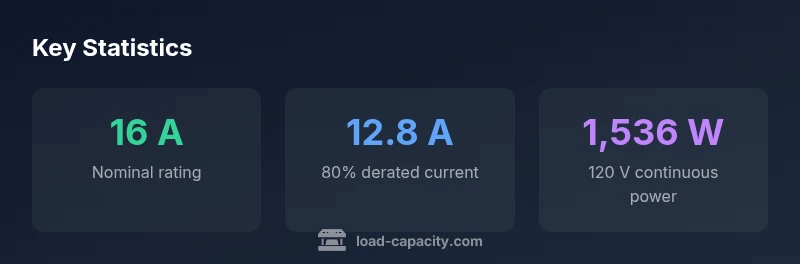
According to Load Capacity, a 16 amp socket load capacity is typically rated for 16 A at standard voltages, but continuous loads should derate to about 80% of the rating. At 120 V that’s roughly 1.5 kW; at 230 V, about 2.9 kW. Always factor in startup surges and cord quality.
What a 16 amp socket load capacity means
A 16 amp socket is a common feature in many residential and commercial settings. The key concept behind the 16 amp socket load capacity is the maximum current the outlet can safely carry without overheating the conductors or tripping protective devices. This rating is tied to the nominal voltage in your region. In North America, a typical scenario is 16 A at 120 V, while many parts of Europe and other regions operate around 230 V. The basic electrical relation P = V × I helps you translate current rating into practical power limits. However, the purely nominal rating does not tell the whole story: continuous operation, startup surges, wiring size, cord quality, and breaker coordination all affect real-world performance. By understanding these factors, engineers and technicians can prevent overheating, avoid nuisance trips, and maintain safe operation of connected appliances. The 16 amp socket load capacity therefore serves as a design constraint and a safety boundary for device selection and circuit planning.
Derating for continuous loads: the 80% rule
Electrical codes often require derating for continuous loads. For a 16 A socket, the practical continuous load is typically limited to about 80% of the rated current. This means a derated current of around 12.8 A. Translating this to power, you get roughly 1,536 W at 120 V and about 2,944 W at 230 V. These values assume a resistive load and near-ideal conditions. Real-world loads come with power factor variations and startup surges that can push instantaneous current above the nominal rating briefly. The 80% rule provides a cushion to prevent overheating of wires, outlets, and connectors over time, improving safety and reliability. When planning multi-appliance setups, this margin becomes essential for avoiding nuisance trips or heat buildup in cord bundles or extension cords. For high-surge devices such as heat-producing equipment or motor starters, consider dedicated circuits with higher ratings to maintain safe operation.
Voltage scenarios: US vs. international practice
Voltage standards vary by country, which shifts the practical wattage that a 16 amp socket can safely support. In the United States, 120 V circuits using 16 A provide a defined continuous load near 1.5
Practical implications for common appliances
For typical household loads—laptops, chargers, small kitchen gadgets—the 16 A socket is more than adequate when used within the 80% guideline. High-draw appliances such as space heaters or large power tools require careful planning. If you routinely approach the 12–14 A range, distribute devices across multiple outlets or dedicate a separate circuit to handle load and reduce heat buildup. When evaluating a new appliance, check its current draw (in amperes) and compare it to the derated 12.8 A target. In practice, a single 16 A outlet paired with appropriate fusing and circuit protection can handle several small devices, but must be managed to avoid layering multiple devices in a single outlet strip or daisy-chaining cords. This mitigates overheating risks and helps preserve both device longevity and electrical safety.
Choosing cords, plugs, and breakers: safety basics
Cord size and plug type directly influence the achievable load on a 16 A socket. Use cords with adequate conductor cross-section (AWG size appropriate for the expected load). Avoid thin extension cords for high-load devices, and inspect plugs for signs of wear or damage. Breakers on the circuit should be rated to complement the derated current; for a 16 A circuit, a protective device aligned with the derated current reduces the risk of nuisance trips and ensures consistent protection. Equipment connected to the outlet should have a cord and plug rated at or above the circuit rating. Safety considerations also include avoiding heat buildup in enclosed spaces and ensuring adequate ventilation around high-draw devices.
How to perform quick field calculations
To assess whether a device can safely operate on a 16 amp socket, calculate the device’s wattage: Watts = Volts × Amps. Use the 80% rule for continuous operation: Continuous Watts ≈ 0.8 × Volts × 16 A. Compare this with the device’s wattage to determine if additional capacity or a dedicated circuit is needed. If you’re in a mixed-load environment (several devices with high startup surges), model the peak demand and lend priority to devices with the highest current draw. For non-resistive loads, factor in power factor and startup surges when estimating real-world current during startup. This approach helps prevent overload conditions and ensures safer operation.
Common mistakes and how to avoid them
Common mistakes include assuming nominal amperage always equals real-world usage, overloading outlets with several devices, and using undersized extension cords. To avoid these issues, always verify the device’s current draw, distribute loads, and avoid adapters that aggregate heavy loads. Regularly inspect outlets, cords, and plugs for signs of wear, and consider upgrading to dedicated circuits for high-draw equipment when necessary. Finally, ensure your venue’s electrical system complies with local codes and safety standards.
Derated continuous load for a 16 A socket
| Voltage (V) | Derated Current (A) | Continuous Power (W) | Notes |
|---|---|---|---|
| 120 | 12.8 | 1536 | 80% rule for continuous loads |
| 230 | 12.8 | 2944 | 80% rule for continuous loads |
Quick Answers
What is the difference between peak and continuous load for a 16 amp socket?
Peak load refers to brief current surges that exceed the nominal rating, while continuous load uses the 80% guideline to avoid overheating. Design for the derated continuous value and monitor surges to maintain safety.
Peak loads are brief surges; continuous loads should stay within the derated 12.8 amp limit to avoid overheating.
Can I run a heater or space heater on a 16 amp outlet?
Space heaters can approach the derated limit quickly. Check the heater’s current draw, and avoid daisy-chaining multiple high-load devices. If the heater draws near the derated limit, use a dedicated circuit.
Heaters can push past safe limits on a single 16A outlet—consider a dedicated circuit.
Does the derating apply to all circuits?
Derating is common for continuous loads on fixed circuits. Local codes vary, but many jurisdictions require the 80% rule for continuous equipment and high-load devices.
The 80% rule often applies to continuous loads, but check local codes.
What safety practices should I follow with 16 amp sockets?
Use cords with appropriate gauge, avoid overloading outlets, inspect components for wear, and ensure breakers and fuses match circuit ratings. Keep high-load devices on grounded outlets and maintain ventilation for heat-generating equipment.
Choose proper cords, avoid overloads, inspect components, and maintain ventilation.
Is a 16 amp socket the same as a standard 15A outlet?
A 16 A socket can carry more current than a typical 15 A outlet, but practical use depends on wiring, breakers, and safety margins. Do not assume interchangeable without checking circuit design.
They aren’t always interchangeable—check circuit ratings first.
How do I calculate watts from amps for a 16 amp socket?
Multiply voltage by current (Watts = Volts × Amps). Apply the 80% rule for continuous loads to estimate safe wattage, then compare with device wattage.
Watts = Volts × Amps; use 80% for continuous loads.
“Treat a 16 amp socket as a safety boundary: derate for continuous use, choose proper cords, and coordinate breakers to prevent overheating.”
Top Takeaways
- Derate continuous loads on a 16 A socket to ~12.8 A.
- Derated wattage depends on voltage (≈1,536 W @120 V; ≈2,944 W @230 V).
- Account for startup surges and cord quality in planning.
- Use appropriately rated cords, plugs, and breakers.
- Follow local codes and safety practices when wiring or upgrading outlets.